Skills in Demand Visa (Subclass 482) to Permanent Residency (PR) in AustraliaGetting a job in.......
Read full post
Share this article:
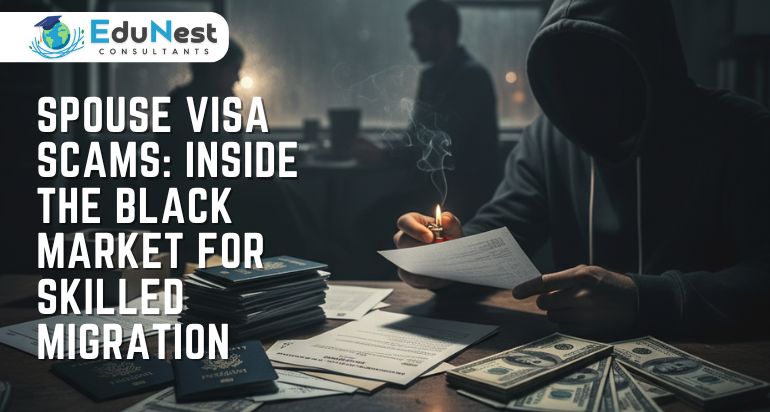
Applying for a skilled visa in Australia is a life-changing opportunity. From better career prospects to a secure future, permanent residency (PR) is the ultimate goal for many international students and skilled workers. But where there’s high demand, scams often follow.
One of the most alarming trends today is the rise of fake spouse visa scams in Australia, where unregistered migration agents sell “spouse” spots in skilled visa applications to desperate applicants. What may look like a shortcut to PR can quickly turn into financial loss, visa refusal, or even deportation.
This blog explores how these scams work, why people fall for them, and what you can do to protect yourself.
Australia’s skilled migration program allows a primary applicant to include a spouse or dependent children in their application. This rule is meant to help families stay together. However, in the black market, these “secondary applicant” places are being sold to strangers.
Here’s how the scheme usually unfolds:
Recruitment via online apps: Popular social platforms like Xiaohongshu or community forums are used to advertise opportunities.
The promise: Agents claim they have a “high-scoring” primary applicant ready to add a secondary applicant for subclass 189 or 190 skilled visas.
Faking relationships: To trick the Department of Home Affairs, fake couples are instructed to take staged photos, create joint bank accounts, and even generate fabricated utility bills to appear as de facto partners.
Upfront payments: Victims often pay deposits of thousands of dollars, only to later discover that no visa application was ever lodged.
What begins as an attempt to secure a permanent future in Australia often ends in heartbreak and huge financial loss.
Understanding why these scams succeed is critical. Many skilled visa applicants — particularly international students — face intense pressure to secure permanent residency quickly.
Here are the main reasons people take the risk:
Low migration scores: Some applicants don’t meet the points threshold for skilled migration visas.
Time pressure: Age limits and changing immigration policies push applicants to act fast.
Financial stress: Having already invested heavily in tuition fees and living costs, some see buying a “shortcut” as less risky.
Trust in agents: Unregistered agents often present themselves as legitimate professionals, complete with offices and contracts.
This combination of urgency and hope makes applicants vulnerable to exploitation.
Falling into the trap of a skilled visa scam in Australia can have devastating effects. Victims don’t just lose money — they put their entire future at risk.
Some common consequences include:
Visa refusal: Submitting false information can result in rejection and a three-year ban from applying for most visas.
Deportation risks: If fraud is detected after a visa is granted, the visa can be cancelled.
Criminal penalties: Providing false or misleading information carries large fines and even possible jail time.
Emotional toll: Victims often suffer stress, shame, and uncertainty about their future in Australia.
Instead of fast-tracking permanent residency, fake spouse visa scams usually leave applicants with nothing but regret.
The Australian Government is taking steps to crack down on unlicensed migration agents and fake spouse schemes.
Public warnings: The Department of Home Affairs regularly issues notices reminding applicants that using false information or fraudulent documents is illegal.
Targeting dodgy agents: Several agents operating unlawfully have already been detained or deported in states like Victoria and Queensland.
Legal powers: Authorities can cancel visas, impose bans, and even pursue criminal charges against those involved in visa fraud.
But despite these measures, scams continue to thrive, particularly online. That’s why awareness and prevention are key.
Protecting yourself from these scams means being informed and cautious. Here’s what you can do:
Verify your migration agent: Always check that your advisor is registered with the Office of the Migration Agents Registration Authority (OMARA).
Avoid guaranteed promises: No agent can guarantee a visa approval — if they do, it’s a red flag.
Don’t pay cash deposits: Legitimate professionals provide official invoices and receipts.
Research skilled visa pathways: Visit the official Department of Home Affairs website to understand how subclass 189 and 190 visas work.
Seek legal advice: When in doubt, consult a licensed migration lawyer instead of risking your status on shortcuts.
Fake spouse visa scams don’t just harm individuals — they undermine trust in Australia’s immigration system. They also highlight a deeper issue: the complexity and competitiveness of skilled migration pathways.
Clearer communication about visa requirements, better support for international students, and stricter monitoring of online platforms could help reduce the demand for these black-market schemes.
The rise of spouse-for-sale scams in skilled visa applications is a warning for anyone pursuing permanent residency in Australia. While the promise of a quick solution may sound appealing, the risks far outweigh the rewards.
The best way forward is to use licensed migration professionals, follow official channels, and avoid shortcuts. Permanent residency is possible — but it requires patience, planning, and compliance with the law.


Level 10/550 Bourke St, Melbourne VIC 3000, Australia
Level 1, 5 Corundum Lane, Truganina VIC 3029, Australia
